

The Laurentian Library
The first corporate reading room, and why we should pay attention today
Arguing that the Laurentian Library (Biblioteca Medicea Laurenziana) was the first true corporate library reframes our view of the Medici. Before they were rulers, dukes, or popes, the Medici were the executives of Europe’s most powerful multinational: the Medici Bank. While others built printing presses, the Medici acquired source books and manuscripts to protect and project.Other libraries sat in quiet monasteries or were hoarded by kings. The Laurentian was different. When Pope Clement VII de’ Medici commissioned Michelangelo to build it in 1524, he was not building a store for books.1 He was executing a masterclass in knowledge management.
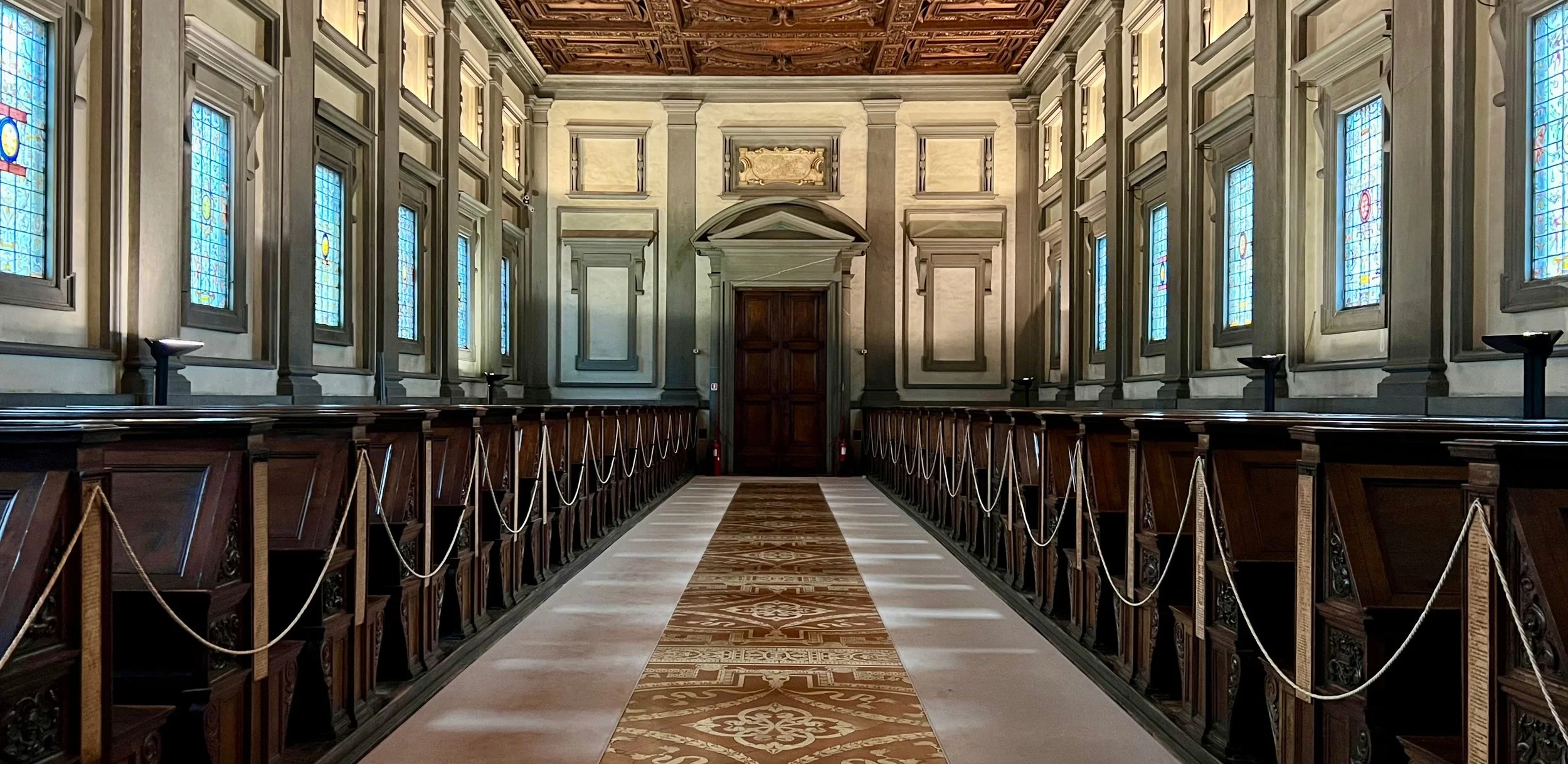
The Laurentian Library in Florence, Italy.
Ada Palmer’s Inventing the Renaissance2 dismantled the romantic version of the era. The reality was desperate, war-torn, and plague-ridden, not the sudden, spontaneous burst of genius we associate it with today. It was old knowledge, recovered and read: the Greek and Roman classics. By the time Clement commissioned the library, Gutenberg’s press had been flooding Europe with printed books for eighty years. It made information accessible and abundant. But printers still needed accurate, original manuscripts to copy from. The Medici collected both: 11,000 manuscripts and 5,000 printed books. They held the source code of the Renaissance. But they did not hoard it. The Laurentian put that knowledge capital to work. If a scholar wanted to translate a newly discovered Greek text, he sat in a Medici building, reading a Medici book. He left educated, and the Medici influence grew.
Informed vs. Educated
Five hundred years later, the flood is back, and it moves faster. Generative AI performs knowledge on demand, and the performance is everywhere. The corporate workforce of 2026 is more informed than any in history and less educated than any in fifty years. The two are not the same thing, and the difference will decide who directs AI and who is directed by it.Informed is a stream. Podcasts on the commute. Newsletters. Social media. LinkedIn posts. Summary apps. Slack threads. Elearnings. AI chat outputs. The informed person stays current. They perform well in meetings. The stream washes through at high velocity and leaves a residue of context that is wide and shallow. Informed is necessary. Informed is not enough. And AI is about to perfect the informed workforce.Education is a structure. Deep thought, experience, and books build the architecture in the mind that lets new information be placed, weighed, compared, and integrated. The educated person builds and executes strategies, expressing wisdom. Long-form reading creates the analogical patterns, the vocabulary depth, the muscles for structured argument, and the capacity for sustained reasoning. The structure stays.The Medici knew that staying current was never the same as owning the source. The source is what it has always been: deep thinking, the full book, and the mind it builds. The educated mind directs AI. The “informed” mind is replaced by it.
Getting Serious About Corporate Education
The shadows in Plato’s cave have gone full color at 5K resolution. Content and information are about to take an exponential leap off the cave wall. Learning “in the flow of work” will soon be the domain of AI, and shortly after, the “informed” work it was instructing will be too. Take books as an example: almost every competitor in the corporate reading space sells the performance of reading. One condenses books into fifteen-minute summaries; another sells bite-sized excerpts of expert knowledge. Those business models are dying; AI will replace them. AI informs on demand, on anything, in any form, for a fraction of the cost.A CEO creates a reading list: “Here are the books that build deep knowledge for our market, our industry, our time.” The list is shared across every social channel. But the books are not read; instead, they are listed on author podcasts, scanned in articles, or fed into summary engines. The workforce is informed. But no deep learning occurs. Nothing is traced, tracked, or integrated into our systems of learning. The reading list is projected as “inform,” and it remains social noise, chatter, detached from the architecture of education.When the Medici saw the printing press, they did not chase printing. They engaged Michelangelo to build a “stairway to heaven” to elevate learning.We have been seduced by the same burst of genius Palmer dismantled, now represented by AI’s hyped promise: instant mastery without the work of comprehension. We need to do the hard work of building our own Medici Library.
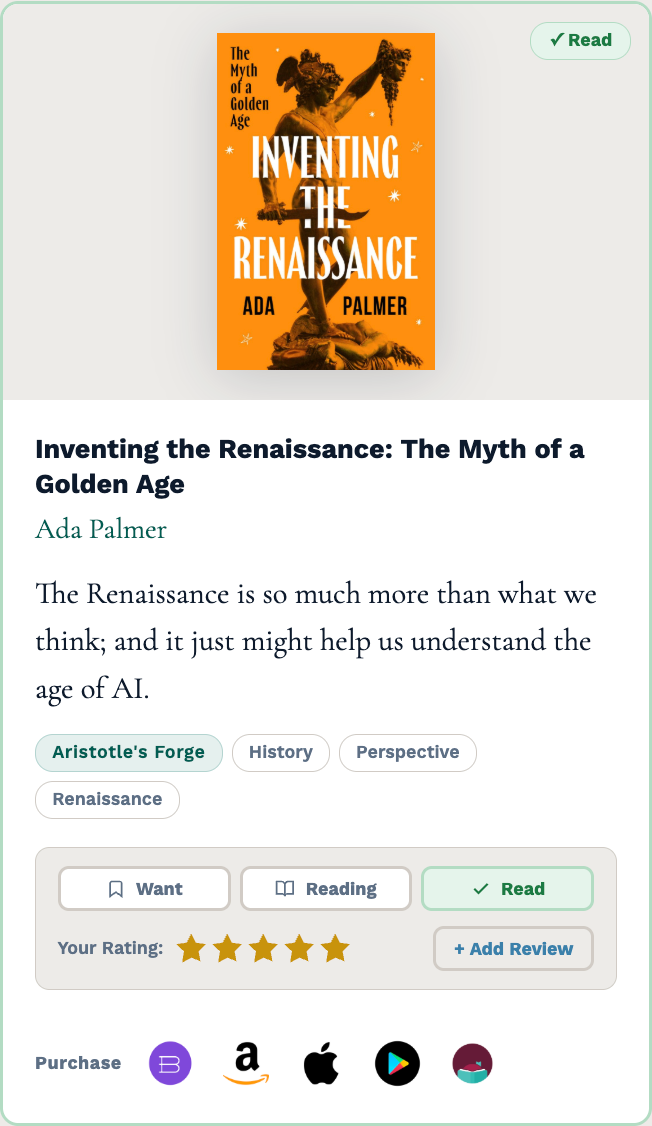
What if the full book became accessible in the architecture of corporate learning? SmarterReads adds reading room of sources to the LMS.
Generational Knowledge Transition
Why do experienced leaders report increasing productivity with AI while the youngest workers struggle or even reject its usage? Experienced workers possess the deep, structural knowledge to separate the signal from the noise. They instantly correct or ignore what doesn’t hold up.“Workers gain the most from AI when they understand their work deeply. But they build that understanding by doing the work they’re now offloading.” 3Without that structural foundation, younger generations must face AI output head-on and fight through its plausible outputs. Experienced minds can set aside what others must spend hours reasoning through. Gen Z is starting to reject what comes without assurance and real-world opportunities. They don’t want more summaries; they need education. They need a practical space to experiment, build, and renew deep knowledge.
Rebuilding Corporate Learning
Clement VII’s response to the printing press was not to commission a print factory. He commissioned Michelangelo to build a cathedral for the source. Corporate learning must move away from “inform.” AI will soon automate the generation and dissemination of “inform” anyway.The Learning Management System (LMS) could be the single greatest asset we have for the age of AI, but we have to think about it differently. It must become our own secure space for acquiring, protecting, and projecting source knowledge: the proprietary IP, the unique story, and the strategy of the organization. And most importantly, it must be the place for employees to acquire and to practice it. Every organization already has an LMS. The question is whether we use it to inform or to educate.
The Laurentian Library, Patronage and Building History by Silvia Catitti
https://www.academia.edu/33872589/The_Laurentian_Library_Patronage_and_Building_History
Inventing the Renaissance The Myth of a Golden Age by Ada Palmer
The Augmentation Trap: AI Productivity and the Cost of Cognitive Offloading by Michael Caosun and Sinan Aral