

What a Tuesday in November 1989 Can Teach Leadership About AI
Instructive vs Directive
On the morning of Tuesday, November 14, 1989, I walked into my political science lecture hall at the University of New Hampshire. Professor Trout stood at the lectern. The semester’s books were stacked beside him, and we assumed the next lecture on Soviet foreign policy was ready to go. Instead, he announced a change to the curriculum. He swept the entire stack into the dustbin.
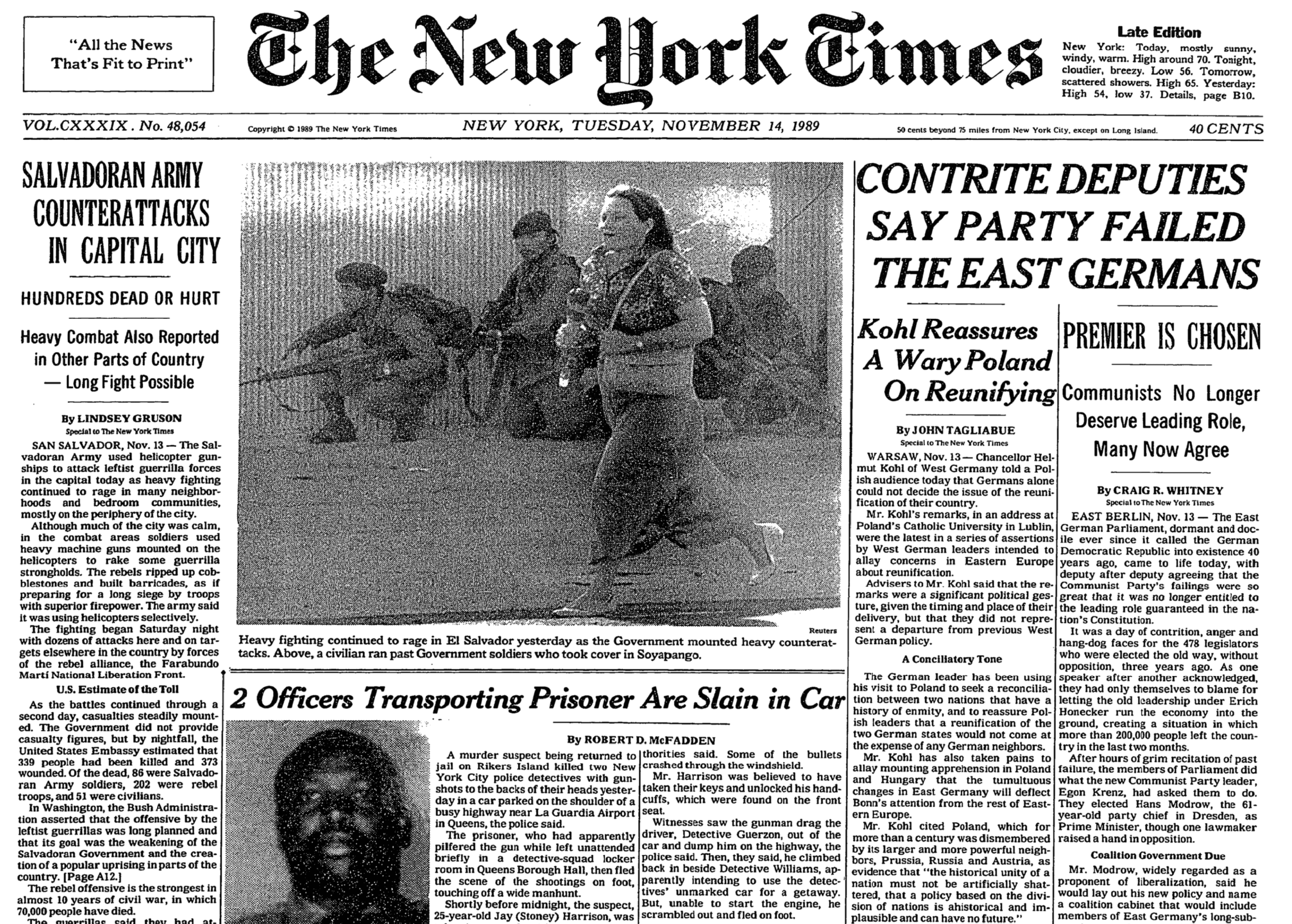
Front page from the New York Times November 14th 1989. Courtesy NY Times Time Machine.
The Thursday evening before, the Berlin Wall had come down.
Those dozen books were still accurate. But their context had vanished, and their perspective was obsolete. The urgency, Professor Trout stated, was to adapt. We would spend the rest of the semester reading The New York Times, The Financial Times, and The Economist to understand the shifting world. Our syllabus became plain: stay informed, share what we learned, and decide together what came next. Our research would be what we found. Our papers would be what we made of them. Our exams would be our thinking.
We were moving forward together into uncharted territory. Explorers, using different perspectives to navigate the unknown.
I still think about that pivot. He did not try to jam the new reality into an old framework, nor did he compromise between them. He pivoted cleanly. And he did not set his hard-earned knowledge aside to do it. He held onto his decades of experience and used that authority to lead us through the tumult. His tenure alone would have allowed him to treat the fall of the wall as a mere footnote and continue on. Yet, he chose the harder, more authentic path. He was no longer instructing; he was directing.
Since ChatGPT arrived in November 2022, many organizations have set out to instruct their workforce on AI. Most are doing the opposite of what Trout did. They apply AI to the frameworks they already have, without asking whether those structures are still relevant. They use a general-purpose technology merely to optimize old tasks, running a new world through an ancient lens rather than pivoting to discover.
Mastering this shift requires discarding the workflows we arrived with. Leaders must become like Trout: guides who use hard-earned experience to offer perspective on a shifting world. Direction over Instruction.
Professor Trout finished the semester with the story of why he pivoted. In August 1968, a reporter asked him about US-Soviet relations during the Prague Spring. His framing concluded the Soviets would let the reforms stand. The next day, Soviet tanks rolled into Prague.
His authority was undeniable. His mistake was not the prediction. It was the framework events had already overtaken. When everything changes, instruction relies on unearned conclusions. Use knowledge to direct our gaze, not to tell us what to see.